
Zero Waste Week is fast approaching. 7th September marks the beginning of the 13th year the campaign has been running.
It may be that our attention has turned this year from the environment to other more pressing worries connected to You Know What. I know that shopping during lock down brought some challenges to my principles. Organising online shopping as much as possible for us and Mr S’s mum, who is a dialysis patient and thus quite vulnerable, meant that suddenly our groceries were arriving with more plastic bags. (That annoying situation where one item is put into one carrier bag….)
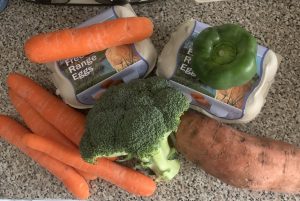
We did partially mitigate this by using our local farm shop, taking our own containers, when we couldn’t get a slot at the supermarket, and using smaller local shops too.
I also bought disposable masks early in the pandemic. Fortunately, now reusable cloth ones are available pretty much everywhere. It does make me cross to see so many of the single use ones, along with plastic surgical gloves, littering the pavements.
How easy is zero waste living?
I should make it clear at this point that by no means do we live a zero waste lifestyle. The way that our society is organised makes this almost impossible for the average person, especially if you are on a budget. I find this a rather frustrating challenge.
We don’t all have the time or money to buy all of our food loose and organic. I have attempted to buy as much as I can this way. The first trick is finding food that isn’t already wrapped. Sure, you can buy some produce loose in most supermarkets, but it still tends to cost more than buying it ready packaged in plastic bags or film.
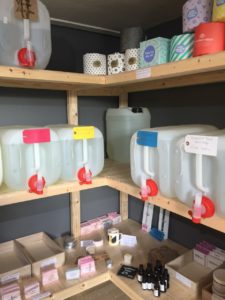
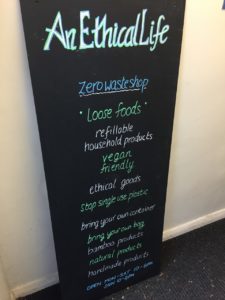
We briefly had a zero waste shop in our town, but it came and went quickly. It also had a very limited range of products and they were expensive.
I have taken myself into town from time to time and bought fruit and veg from the market (cheap but not always great quality), fish from a mobile stand (fabulous, but very expensive) and meat from the one remaining independent butcher. But I still had to go to the supermarket to buy toiletries, pet food, loo roll, cans of tomatoes, etc., which all took hours longer than usual.
You can get some decent veg boxes delivered locally, but again they are expensive and the contents aren’t always suitable for someone who reacts to certain foods (me!).
Despite the obstacles, we do what we can, avoiding plastic as much as possible, buying second hand and avoiding food waste. I would love to take this up a notch, so I am looking for inspiration during this year’s Zero Waste Week.
Pressing for change
I massively admire those who have total dedication to a zero waste lifestyle, such as the amazing Bea Johnson, but if we are going to really reduce the amount of waste we produce as a society, it needs to be made easier for the average person.
In my view, it needs to come about through public policy, not just consumer pressure. Manufacturers and retailers will mostly pay lip service to reducing the waste they create until they are forced to change.
The answer isn’t to recycle more; it is to reduce the amount of waste we produce in the first place.
All this isn’t to say that we can’t all do more as individuals. There are a ton of small actions the average citizen can take. If you would like some ideas and inspiration to do this, please check out the following posts:
Reduce food waste: 10 ideas to use your leftovers
More ideas to help reduce food waste
20 things I don’t buy to save money and waste
Best zero waste Christmas gifts
10 easy ways to cut your plastic waste today
Why buying second hand clothes is good for your wallet and the planet
Why you should buy second hand
How can you reduce the chemicals in your home?
Can you do eco-friendly cleaning on a budget?
To sign up for the campaign newsletter and find out more about Zero Waste Week, click through here.
Have you been striving to reduce waste in your life? What changes have you made, or what difficulties have you encountered?

Farn says
I can really relate to this – aiming for zero waste when you’ve only got mainstream supermarkets to shop in is totally impossible, and alternatives can be really expensive.
We’ve kept costs low by growing little bits here and there – mint and camomile for teas, a few lettuces (which bolted and took over the raised beds) and some garlic and peas from the kitchen cupboards. There’s no way this could be our only source of food, but it does remove some of the more expensive and most wasted items from our shopping basket i.e. fancy teas, herbs, and bags of salad.
We’ve also bought veg via our local CSA project which has been so exciting! https://communitysupportedagriculture.org.uk/ You effectively buy a ‘share’ in a farm and get an equivalent quantity of produce in return. We’ve had so much that I’ve taken to freezing courgettes and chard for the winter months, and am having a go at making blackcurrant wine!
I’m looking forward to seeing how you get on this year 🙂 Good luck!
shoestringjane@outlook.com says
The CSA sounds great! Our lettuces bolted too although we did manage to eat some
Julia Foyle says
I’ve always said that what we consumers buy is industry led, and that the consumer has little choice if they are to buy anything at all – be it items wrapped in plastic to cheap, poor quality items designed to be thrown away and replaced rather than lasting and/or being repaired
If the industry changed its ways the consumer would have little choice but to follow. – we are lazy creatures of habit – especially where something dull like grocery shopping is concerned! We do what is simplest and easiest for us. We shouldn’t be the ones constantly having to strive to find a better way!
Yes, glass is heavier, more expensive to produce and risks breaking if dropped but being the same age as you I remember when that was the norm! If sugar and flour can come in a paper container, why cant other items such as toilet paper, kitchen towels, or any other dry goods?
Plastic carrier bag use has fallen, but so many now buy more expensive Bags for Life each time they shop instead! The industry should be making sturdy paper bags or better still cheap fabric ones that people might me more reluctant to throw away. All of the bags I use for the supermarket are made from varying fabrics and all of them came free as goodie bags or promotional giveaways! Some of them are little more than felt but I’ve been using them for at least 15 years now!
If the industry changed the way it does things, we would have no choice but to follow. The continuous stream of plastic needs to be stemmed at its source. All we are doing is continually dabbing away at the flood it produces downstream. 🙁
shoestringjane@outlook.com says
I totally agree with everything you just said, Julia. You really should start a blog!!
Moira Sutherland says
In France Spain and Italy while traveling I would buy one of things like tomato onion etc they were weighed then put in one bag with all the price stickers on the outside.
Julia says
You can do that in the UK too now – at least in Sainsburys.
I tried the ‘one bag for all method’ once but when I went to the self-checkout and scanned the first label it wouldn’t let me go any further as I had to put entire bag of loose veg into the bagging area and didn’t like it when I scanned the next label and had nothing to put there!
So I just use their reusable bags for each group of items separately now – and don’t bother printing a label, but weigh them at the till! 😀