

Have you ever considered eco-friendly cleaning products? Maybe you have made your own? I am sure I am not the only one looking at a gentler way to clean the house. However, can you do it on a budget?
A chemical cocktail
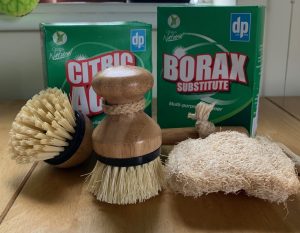
Many of us use a multitude of household cleaners. One for the bathroom, another for the kitchen. Something for the oven and a different product for the sink. Window cleaning sprays, powders to sprinkle on the carpets, bleaches and toilet cleaners, spray polishes, laundry products, dishwasher tablets, washing up liquids and floor cleaners. These all combine to make a chemical cocktail in our homes that can’t be good for us. We then add to this indoor pollution by plugging in air fresheners! Sounds like a recipe for disaster to me.
All of the chemicals in these various products, not to mention the plastic bottles they tend to arrive in, also have potentially negative implications for the wider environment. In addition, you can spend a small fortune on this stuff!
So, how can we reduce this chemical cocktail and create a healthier environment for ourselves, our families and the planet?
Reduce the number of products

You can reduce the number of chemicals you use when cleaning simply by using fewer products. Our great grandparents would have been totally befuddled with the choice. They cleaned with carbolic soap, soda crystals, hot water and elbow grease.
I am not saying there was no room for improvement, but it is an illustration of how we got by perfectly well without so many detergents and cleaning products.
A single general purpose cleaning spray can be used in the kitchen and the bathroom, for example! A big, cheap bottle of disinfectant in a bowl of hot water will do all your surfaces and floors.
Make your own
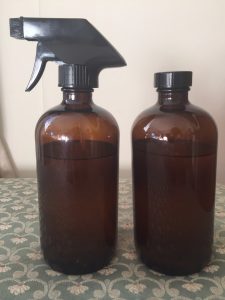
I make my own eco friendly cleaning spray from time to time and use lemon peels in this recipe. They are not as powerful on really dirty areas but I try not the let the house get that bad.
You can use products from your larder, such as lemon juice, white vinegar and bicarbonate of soda to clean pretty much anything. Cass over at Diary of a Frugal Family makes her own window cleaning spray and even an alternative to Febreze!
I have used a vinegar and water mix instead of a window spray or furniture polish for years and it works perfectly well. In addition, I have a small bottle of linseed oil to put on wooden surfaces every now and again.
Making your own eco-friendly cleaning products saves you lots of money and is much kinder to planet Earth.
Buy eco-friendly cleaning products
Not everybody has time to make their own eco-friendly cleaning stuff, of course. But there are so many products available, even for those of us on a budget.

I was amazed to find Carbolic Household Soap *

Soap Nuts


Ecover is another favourite of mine for really effective eco friendly cleaning. They use plant based ingredients and, although they do use plastic packaging, say they are on a mission to stop their use of virgin plastic.
I have used their all purpose cleaner, multi-action spray and toilet cleaner, which I bought when they were on offer in Sainsbury’s. However, the Wilko cleaning range is probably more budget friendly and I buy these products more frequently.
These, along with my vinegar spray and bicarbonate of soda are pretty much all I need for my eco-friendly cleaning routine. I use them quite sparingly as they are pretty powerful.
Yes, I could go back to buying all the cheapest cleaning stuff from Aldi, but whilst I have the option I am happy to pay a little more for eco-friendly cleaning products.
Think about the packaging
Just considering the packaging can give you a more environmentally friendly option.
Buy laundry powder rather than liquid, as it comes in a biodegradable cardboard box. Buy soap in solid rather than liquid form and there will be no plastic bottle to recycle. White vinegar tends to come in glass rather than plastic bottles, which is another good reason to use it.
Make sure packaging is recyclable then ensure you recycle it! Avoid products that are ridiculously over packaged. It might be a silent protest, but maybe manufacturers will stop doing it if we all refuse to buy these things.
Do you try to avoid too many chemical nasties in your home? Which eco-friendly cleaning products do you find effective?
This post contains affiliate links marked with *. If you click through and make a purchase, I will earn a small commission. Thanks!

Margaret Powling says
You can buy it through a company called Starbrands, Jane.
Margaret P
Margie From Toronto says
I use baking soda, vinegar and water whenever possible. However I still do use bleach to disinfect (especially if I’ve used raw meat on a cutting board – that sort of thing). I do use a furniture spray – but only dust about once a week 🙂 – liquid soap is recommend for the washing machine but the container is recyclable here. I use bar soap in the shower but liquid soap at the sink – but I buy it in large bottles and keep refilling the counter size bottle – and again, these are both recyclable where I live. I try to avoid all scents due to allergies and avoid things like tile & toilet cleaner which are so strong that the one time I tried it I could hardly breath – had to open every window in the apt. to try to get rid of it. Immediately gave it away to the person who had recommended it.
shoestringjane@outlook.com says
That’s terrible! This is why I dislike such strong chemicals, especially when you might mix them
Julia says
I use the Wilko “Doesn’t Cost the Earth” range for toilet cleaner, dishwasher tabs and washing up liquid.
The latter two are fab, and the washing up liquid in particular lasts much longer than the small bottle would suggest, but I’ve recently fallen out of love with the toilet cleaner a bit as it doesn’t seem to be doing such a good job anymore.
That could be down to having hard water, or having 5 males in the house 24/7 – neither of which help in the slightest- but I’ve noticed that where there’s limescale deposits they’ve slowly started turning yellow over the years which makes the whole lot look grubby.
shoestringjane@outlook.com says
I use that range too but do chuck the odd bit of bleach or vinegar down the loo as well on occasion for the same reason