
I know that many people are using this enforced period off work to have a good declutter. It’s so therapeutic to have a clear out, especially in the spring! New beginnings and all that… So how about using this as an opportunity to make some extra cash by selling your old stuff on eBay?
I have been selling on eBay for several years now. At some points, the extra cash has made a massive difference to our budget when money has been particularly tight.
Your unwanted clothing, children’s toys, homeware, books, computer games, furniture and so on – in decent condition, of course – could be just what someone else needs and save them some money too.
I also like the idea of encouraging a circular economy. Buying and selling second hand is good for the environment as well as your wallet!
Here are some hints and tips for selling your old stuff on eBay. Please note that this is a general guide and some points might not be appropriate whilst we are on lockdown.
Tips for selling your old stuff on eBay
What sells?
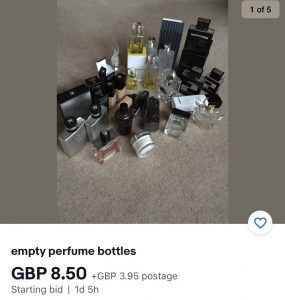
A better question would be, ‘What doesn’t sell?’ People sell all kinds of weird and wonderful stuff, from used loo rolls to empty perfume bottles. However, there are obviously some items that will be more in demand. The time of year can also impact this, but having said that I have heard that people do weirdly buy Christmas jumpers in April!
Certain designer clothing names sell well and for high prices. As long as they are in good condition, they can command a very good price. High end brands such as Ted Baker, Ralph Lauren and LK Bennett sell well. Karen Millen, Mint Velvet and Phase Eight cost quite a lot to buy new but don’t always sell quickly or for that much.
Also popular are brands that are cheaper to buy in the first place, such as Top Shop, M&S, Per Una, Monsoon, White Stuff, Lipsy and Jane Norman.
Shoes don’t always sell that well, but I have found that people look for reliable quality brands such as Clarks and Hush Puppies.

Vintage clothing and homeware is quite niche but will sell too. Prepare to wait a bit longer for this to be purchased. I have found that homeware sells more quickly than clothing, but it will depend what you have.
Unusual kitchen and home ware items sell well generally, as does furniture, although you need to take into account how difficult or expensive items will be to pack and send. Sometimes it is better to choose for the buyer to collect, although that will obviously narrow down the potential market.
Use keywords in your title
It is really important to use keywords in your title that people are likely to search for. For example, you could put ‘Beautiful Top Shop dress size 12’. However, how much better to use something like ‘Top Shop Red Pink Cotton Floral Midi Fitted Wrap Dress UK 12 Eur 40 Summer Sun’?
This has lots of keywords that potential customers might be looking for – you might be able to come up with more. Always try to use the allowed 80 characters if possible. I would generally avoid subjective descriptions like ‘beautiful’ unless you have lots of space to fill.
Just imagine what you would search for if you were looking for a particular type of item. Make sure your keywords are spelt correctly too, particularly brand names.
Fill out the item specifics
eBay appears to like listings where the item specifics have been filled as completely as possible. I have heard that this might make your listing more visible to customers, but this hasn’t been verified. The eBay algorithm moves in mysterious ways!
Either way, the more information you give potential buyers the better.
Describe it well
You need to provide a detailed description of the item you are selling, but be honest. If there is a small stain on the hem or a pull to the fabric, or there is a crack on the china, say so and provide photos. This will avoid battles with disgruntled customers if the item isn’t as they were expecting.
If you are using a PC rather than the eBay app, there is a separate box for condition, so fill that in too.
Use the description section to add extra details too, such as what the item is made of, measurements (use inches and centimetres if possible), etc.
Take some good pics
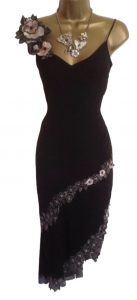 A decent photo really does speak louder than a thousand words. People cannot try items on or feel the fabric so will be reassured to see several good shots from various angles.
Try to use natural light if possible to show the proper colours of your item. Although eBay does now have a tool to remove the background in your photos, I have found an app called Photo Booth is much better.
If you have a lot of clothes to sell, it might be worth investing in a hanging dummy. I bought mine from eBay for around £8. Dress them as they do in the window displays in the shops. Make dresses ‘fit’ with a few pins and add some jewellery.
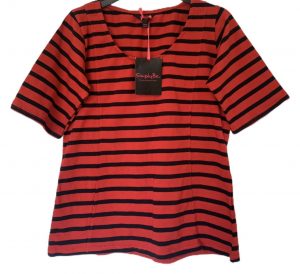 You can also effectively display clothing on a hanger against a blank wall. Items like jewellery, china and other homeware photographs best against a plain black or white background.
Research prices
Particularly when you first begin selling your old stuff on eBay, it is worth looking at how much similar items have sold for to try to establish a good price for whatever you are selling.
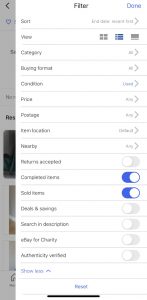
You can search for an item to first see what sellers are aiming for with their pricing of similar items. However, looking at sold and completed listings is by far the best guide to how to price things. Look in the filter section and select sold and completed.
You can also use the filter to select condition. This is useful, as new items will obviously tend to sell at a higher price than second hand.
The screen shot shows what this will look like.
I have found that if you’re not in a hurry you will get more for an item if you sell it at a fixed price – I tend to do this with higher end designer clothing. To sell items quickly it is generally better to opt for an auction. However, sometimes an auction will take off if several bidders are interested in a rare or unusual item. It is worth setting your start price quite high if you think this might be the case.
Even on lower priced items, I can’t see the point of going to all the time and trouble of listing something and then risking an auction ending at 99p! I always start auctions at the lowest price I would be happy to achieve.
Good timing
If you are selling by auction, think about your timing and schedule your posts to end at peak periods. For example, it is better to time your auction to end on a Sunday at 8pm when people have time to browse rather than on a Monday at 10 am when they are all at work! eBay has a scheduling feature for this purpose.
Sell overseas
Don’t be afraid to sell abroad. I have seen so many adverts stating that sellers will only post within the UK. Why? If you are going to the Post Office anyway it is no more complicated to post abroad.
You open up your potential customer base hugely by selling internationally. Do check what the postage cost will be first, though. You can use the Royal Mail Price Finder for this too.
Postage costs
Don’t be greedy with postage – customers aren’t stupid and will be put off buying if you are charging £10 P&P for an object that will only cost £3 to send.
On the other hand, don’t just guess the cost of larger, heavier items or you may find the postage is much more expensive that you anticipated. I learned this one the hard way!!
It’s worth becoming familiar with the Royal Mail’s pricing structures and checking what your item will cost to post BEFORE listing it.
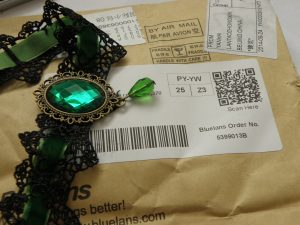
For example, small parcels are quite cheap to post, but if you go over the 2kg weight limit suddenly become much more expensive. I usually weigh the item and check the Royal Mail price finder to get guidance on costs, then add a little extra for packaging.
I recommend sending your package using a signed for service if it is valuable. Check the level of insurance to make sure it will cover the full cost of the item should it go missing.
Even if you send by standard post, always get proof of postage in case the parcel goes astray. If this happens, you can refund your customer and get a refund from the Royal Mail to keep everyone happy.
You can, of course, use services other than Royal Mail. I sometimes use Collect+ if I am selling in the UK. However, I really rate the postage comparison site, Parcel Monkey. It has proved excellent for getting the best price on large or heavy items. I often find I can still send with Royal Mail with a huge reduction if I purchase through them.
Please note – for items that will fit into a post box, you might prefer to buy labels online with the Royal Mail. This saves you a trip to the post office!
Pack well
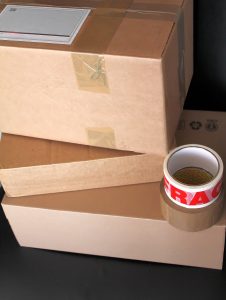
Take a bit of time to pack items carefully. Make sure you use lots of bubble wrap and a decent box if you are posting anything breakable. A roll of FRAGILE tape is a worthwhile purchase if you are selling a lot of homeware or toys.
When selling women’s clothing I wrap it in coloured tissue paper and pop it in a matching plastic envelope. Again, I buy these from eBay as I have found this to be the cheapest place for packaging materials.
Be organised in advance with your packaging. You don’t want a last minute panic trying to find something suitable.
You could also include a little message thanking the buyer for their purchase. Ask them to leave you positive feedback if they are happy with the item or to contact you before leaving negative feedback if not so that you can try to resolve any issues.
The power of feedback
If a customer is not happy with the item for any reason, don’t argue. If you want to make money selling your old stuff on eBay, you need good feedback.
In my opinion, it’s not worth risking your chance to build up some good feedback by quibbling over a return. eBay almost always sides with the buyer anyway! You can contact eBay customer services if you encounter difficult buyers or have had unfair feedback left for you. In some cases you can get this removed.

When you have had a good experience, don’t forget to leave positive feedback for your customer as well – it’s a two way process.
In addition, if you buy items on eBay be sure to leave reasonable feedback for the seller. Many are small businesses and it is hard for them when customers leave poor feedback without giving them the opportunity to put things right.
So, that is my advice on selling your old stuff on eBay, which I hope you will find helpful. Please feel free to add your helpful hints and tips!
Please note that this post is aimed at people selling their own things. If you are buying items with the intention of re-selling them, you do need to register as a business seller with eBay. Buyers are also covered under the Consumer Rights Act, the same as if you were a shop. More information is available here.

Lilian Anderson says
Very helpful.post, I do enjoy your frugal posts, thank you for all your efforts
mommabee says
I don’t have a lot of luck on ebay. Or craigslist. I have great luck on my local neighborhood site where neighbors chat about activities, local issues and put up wanted/for sale items. I’ve sold many things and in two days, I’ve made $155.
shoestringjane@outlook.com says
That’s great! No postage
Annie says
This is all great advice. I have sold quite a few things on eBay and I agree with all of this. I didn’t know about buying shipping materials on eBay. A link would have been helpful if there’s a particular spot. Packing materials can be quite pricey! I do recycle them when I can. And I will have to remember the tissue next time I sell clothes. It does make things seem special, doesn’t it?