
If you are lucky enough to have some outside space, it makes sense to make the best of it. A lovely green space lifts the spirits and gardening itself is an amazing way to get fit and keep the stress of the day job at bay. There are lots of ways to create a beautiful and productive garden on a budget. Here are 15 tips for saving money in the garden.
Saving money in the garden
#1 Grow your own plants from seed
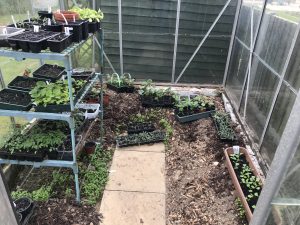
This is the number one way to save money in the garden. I love nothing more than a mosey in a garden centre, but plants can be expensive! Growing your own from seed is so cheap. You can soon fill large spaces with beautiful flowers and if you choose varieties that self seed they will arrive year on year.
At the end of the growing season, you can also save seeds for next year.
#2 Take cuttings
Hard on the heels of tip one, taking cuttings of established plants is another skill worth cultivating. We have a garden full of beautiful wallflowers because Mr Shoestring loves them and is always growing more this way.
#3 Saving money in the garden by making compost
Making your own compost has so many benefits. A lot of wildlife loves a compost heap, it is an eco-friendly way to get rid of raw fruit and vegetable scraps from the kitchen, paper and cardboard, lawn clippings, etc. and it creates wonderful nutrient rich material to feed your plants.
You can create a compost box system out of old wood and pallets, as explained in this Gardener’s World article.
There is a detailed post about making your own compost here.
You can save on compost by filling the bottom section of large pots with old and broken pots and crockery. This helps drainage too.
#4 Create a vegetable patch
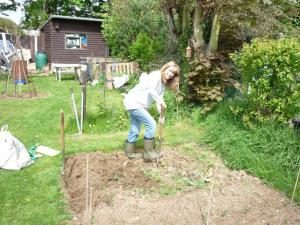
If you have the space for even a small patch, growing your own food is a treat worth the work you need to put in. Even if you only have a patio or balcony, you can still grow your own in containers.
Again, most of your plants will come from seed, so they are cheap to grow. If you share seed packets with friends and family (or on the allotment if you are lucky enough to have one) this can save you even more money.
#5 Grow crops that are expensive to buy
Whilst it is fun to grow onions and potatoes, they are cheap to buy anyway. Asparagus, on the other hand, isn’t! We tend to concentrate our efforts on runner beans (you get a tiny bunch in the shop for a couple of pounds, whereas we have a whole mass of them, which we freeze and eat into the winter months) and soft fruit like raspberries, black currants and gooseberries.
The staples are grown in our garden too, but you can save money on high value crops by growing them yourself. There is a good article about starting a veg patch at Yard and Garden Guru.
#6 Plant a herb garden
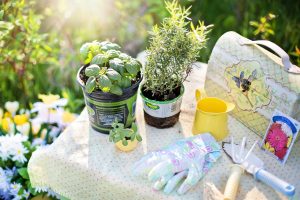
Similarly, if you are a cook, it is easy to spend quite a lot on fresh herbs in the supermarket. Planting your own herb garden near the kitchen will give you a fresh supply all through the summer months, and you can freeze some for winter.
If you don’t want to grow lots of herbs from seed, try potting on the stuff from the shops. This has worked well for us in the past.
#7 Sell your extras
We can’t help but screech to a halt when we pass a little stall selling plants outside people’s houses, so if you have an excess of plants, why not sell them?
#8 Don’t buy pots
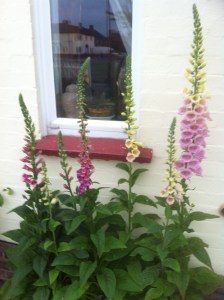
Don’t get me wrong, I love a beautiful container. However, you really don’t need to spend a lot of money on them. I love to recycle pots and containers, which is environmentally friendly as well as saving money in the garden.
You can use almost anything you can make a drainage hole in as a place to grow plants. I keep my old wellies for just this purpose, as they look lovely with some trailing flowers in them. But don’t stop at the small stuff – before you tip your old toilet, just think how good it might look planted up with summer flowers! Painted tyres can be piled up to make little raised beds, too.
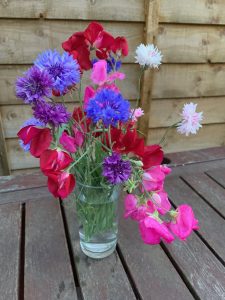
We also keep various plastic food pots and containers for the garden. Black trays from ready meals, which are often not recyclable, are fine used as seed trays, along with mushroom containers, grape pots, etc. Yogurt pots are good for potting your seeds on and also for cutting up to use as plant labels.
Old pots can also be given a new lease of life with a coat of paint. Who hasn’t got a shed full of half-used paint tins?
#9 Buy second-hand tools
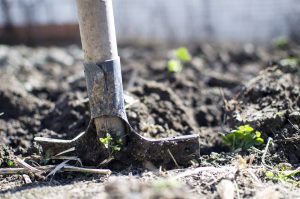
Decent quality garden tools, such as forks, spades, trowels, etc. can cost a pretty penny new. However, we often manage to pick up second-hand garden implements when we go to boot sales in the summer. If they have been used and still look good they were probably good quality in the first place and will hopefully last a few more years.
You can also find tools on Facebook Marketplace or put a wanted request on your local Freecycle group. (Freecycle can be great for anything garden related actually – we have given our excess plants away on there in the past).
#10 Install water butts
It is really important to install water butts in your garden if you want to save money, particularly if you are on a water meter. At this time of year, when it is hot and dry and your plants are thirsty, using the supplies in the water butts first will save you loads. A lot of plants prefer rain water too and it is the environmentally friendly option.
#11 Create a wildlife patch
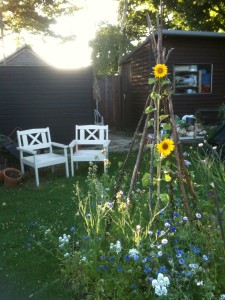
How is creating a wildlife patch saving money in the garden (I hear you ask)? There are many advantages to having a wildlife garden. A wild patch attracts birds, insects, frogs and toads to eat some of the slugs and other pests that frequently visit, it will cost very little and it fills a space.
We have a pile of old branches and twigs at the end of our garden where the stag beetles hatch (and we eventually hope to find a hedgehog), plus areas of longer grass and half a barrel filled with water. Sometimes we chuck a cheap box of wildflower seed in that area but mostly leave it to do its own thing.
It actually saves time as well as money as requires minimal intervention.
#12 Upcycle

Before you rush to the garden centre to buy new garden furniture, can you improve what you already have? Or can you pick up something second-hand but a bit battered and up-cycle it? This is a great way to save money in the garden, as furniture is very expensive.
We still have a lovely bench we found outside a neighbour’s house several years ago. It had no seat but the basic structure was sound. Mr S set about repairing it and I painted it a light green.
We have a pile of old plastic garden chairs that I also plan to up-cycle when I get a minute. Even these came free from a neighbour, but have been kept outside so are rather faded. For around £7, you can pick up a spray can of paint designed for use on plastic
The absolute best example of up-cycling I have ever seen in the garden is from Ilona at Life After Money, who made a summerhouse almost completely from scrap. It is amazing!

#13 Make do and mend
In a similar vein, Mr S hates throwing something away if he can repair it. We are still using a wheelbarrow he pulled out of a ditch. It was very rusty, but he gave it a new sheet of metal on the bottom and it is fully functioning, if not exactly beautiful.
The trick is to think twice before you throw something away to see if there is any way to make do and mend it.
#14 Don’t just buy plants from the garden centre
If you go shortly after delivery, Home Bargains, B&M, Aldi and Lidl are all excellent for cheap plants. I tend not to bother if they have been hanging around a few days though, as they aren’t looked after as well as in the garden centres and can look a bit sad.
Summer fetes and festivals can be good for cheap plants as well, plus stalls outside people’s homes, as mentioned previously.
#15 Check out the reduced section
Don’t just check out the yellow stickers on the food in the supermarket! Sometimes it is worth trying to bring tired looking plants back to life that you find in the reduced section of the garden centre, particularly if they are shrubs or perennials.
These are just some ideas for saving money in the garden. I would love it if you would share some of yours in the comments below.

Julia says
More good tips and I absolutely LOVE that summerhouse!
“At this time of year, when it is hot and dry and your plants are thirsty, .. ” After staring at the non-stop rain this bit did make me chuckle!
Right, now to go read the link you put for container veggies as that’s all I can do in my garden! I did successfully grow 4 runner bean plants in just a small 35cm x 35 cm square pot a few years ago but really want to up my game this year.
Alex says
We do a lot of what you suggest. However, our luck starting seeds has not been good. But we compost and have a bumper crop of Volunteer tomato plants which I hope bear fruit. I am also starting some lettuce and carrots from food scraps. I think I will buy some vermiculite and see if that helps me start things better.
Great ideas!
shoestringjane@outlook.com says
Have you tried using seed compost and getting them started on a window sill? That helped me. I remembered to give them a spray of water every day as well as they were where I couldn’t forget about them.